
Cat-Astrophy builds explained: What changes and what carries over
November 7, 2026Collected Star Fragments can then unlock permanent upgrades, options and routes for future runs.
Cat-Astrophy’s build system is intended to make an expedition feel less like executing a loadout chosen in advance and more like responding to what the run provides. The developer says players find modules during each expedition, then shape a build around what they discover, retain and need in the moment.
That distinction matters for anyone wondering how much control they have over a run. Players can decide which discoveries to keep, how to customise their attacks and which paths to take, but the available systems information does not suggest that every expedition offers a reliable route to one preset combination. The practical question is instead: what is this run providing, and does it currently favour offence, mobility or survival?
Modules form the temporary foundation of each build
According to Heraan Studios’ developer post on Xbox Wire, modules found during a run can alter specific abilities, statistics or systems. Some can evolve, while others reveal synergies when combined with compatible effects.
In practice, that means an unexpected module can give the player a reason to reconsider the direction of a build. The developer’s description identifies movement, attacks and room navigation as parts of an expedition that module combinations can change.
That does not guarantee that a desired combination will appear on demand. Game Critix’s review also found that a newly acquired module could redirect an expedition, while cautioning that finding the right modules early could make a noticeable difference. Players should therefore expect opportunities to steer a build, not complete control over which ingredients appear.
Directional attacks and fatigue discourage simple repetition
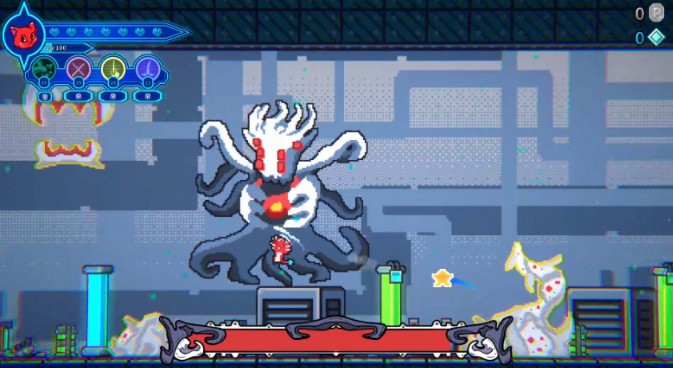
The Xbox Wire systems overview describes separate forward, upward and downward attack variants that can be customised. Those directional options give players more than one combat element to adjust as a build develops.
Fatigue is the other part of that equation. It builds as attacks are chained together, discouraging the player from relying indefinitely on the same repeated action.
Developer Aarón Hernández describes the intended result this way:
“The result is a system that rewards precision and adaptation rather than relying on a single optimal combination.”
That is a statement of design intent from the developer, not independent proof that every possible build is equally effective.
The useful expectation is not that one attack direction will always be best. It is that combat choices, positioning and the modules found during a run are meant to work together. A module supporting movement or a particular ability may be most valuable when it addresses the immediate demands of the rooms ahead, even if it does not fit the plan formed at the beginning of the expedition.
Your route is also a build decision
Build-making does not happen only on upgrade screens. The developer’s Xbox Wire post says planet order, room detours and their rewards can make one route better suited to an offensive setup, while another may favour survival or mobility. Choosing where to go is therefore also a decision about the kind of build the player wants to support.
- Offence: A route may be more useful when its rewards complement a run already developing around damage.
- Survival: A struggling expedition may benefit more from a path that supports a resilient setup.
- Mobility: Movement-oriented choices may be valuable when traversal or room navigation is the more pressing obstacle.
These are broad build directions described by the developer, not confirmed templates with fixed module lists. A sensible approach is to reassess the available paths after meaningful rewards rather than assume that a route is automatically correct because it worked during an earlier expedition.
What remains after a failed expedition?
The modules assembled during an expedition are temporary, but collected resources can contribute to persistent progress. According to the developer’s systems overview, Star Fragments can be spent on permanent upgrades, new options and new routes for later expeditions. Memory fragments reveal more of Polo’s story.
The two progression layers can be separated as follows:
- During an expedition: Modules, evolutions and synergies combine with attack customisation and route choices to form the current run’s build.
- Between expeditions: Collected Star Fragments can unlock permanent upgrades, options and routes for future runs.
The available sources do not establish how many modules or evolutions are in the launch version, how much permanent progression increases baseline power, or whether players can improve their odds of finding a desired synergy. Those unanswered details will affect how deliberately someone can pursue a preferred style over time. For now, the supported expectation is that persistent unlocks broaden future possibilities while adaptation shapes each individual expedition.
The short version: Adapt the plan instead of forcing it
Cat-Astrophy’s stated design is not centred on planning one flawless build and reproducing it every time. Modules can alter abilities and systems during a run, directional attacks and fatigue encourage varied combat decisions, and route choices can support an offensive, mobile or survival-oriented response.
Which modules appear early can still affect how easily a preferred combination comes together, as the independent review coverage notes. The intended play pattern is nevertheless to make use of what appears, then spend collected Star Fragments on permanent upgrades, options and routes that affect future expeditions.
Xbox release and Cloud Gaming availability
For Xbox players, Cat-Astrophy is listed as having released for Xbox Series X|S on 5 November 2026. The official Xbox store page also lists Xbox Cloud Gaming support and states that a game purchase is required. Players should check the storefront for current regional availability and eligible subscription requirements.