Meta’s AI Game Tools and VR Glasses Are Separate: What Creators Can Use Now
September 27, 2026Meta announced two creator tracks at Connect: an early-access prompt-to-game workflow for its social platforms and a Unity-ready SDK path for VR Glasses due in 2027.
The short answer: creators can join the waitlist for Meta’s new AI-assisted game-making tools, but they cannot treat those tools as generally available software. XR developers can access development support for Meta VR Glasses now, including Unity support, but Meta says the device itself will not ship until spring 2027.
Meta’s Connect announcements cover two distinct routes into its ecosystem. Horizon Create and Horizon Studio are prompt-led tools designed to make and publish games through Meta’s services. Meta VR Glasses, meanwhile, are an upcoming VR platform for which developer SDKs are already available across Unity, Unreal, Android and Web.
That distinction matters. The announcements do not say that a game made in Horizon Create or Horizon Studio can be exported to Unity. Nor do the available SDKs mean that a Unity developer can buy Meta VR Glasses today.
What you can use now
- Horizon Create and Horizon Studio: Meta is rolling out early access gradually and directing prospective users to a waitlist. The company says testing is under way with its creator community, with broader access to follow.
- Meta VR Glasses development tools: Meta says its v207 SDKs are available now for Unity, Unreal, Android and Web development, ahead of the hardware’s planned spring 2027 arrival.
- Unity support: Unity says developers can start preparing with Unity 6.6 or later and Meta XR All-in-One SDK v207. That is development readiness, not a promise that an existing Quest build will need no additional work.
Horizon Create and Studio are Meta’s own publishing path
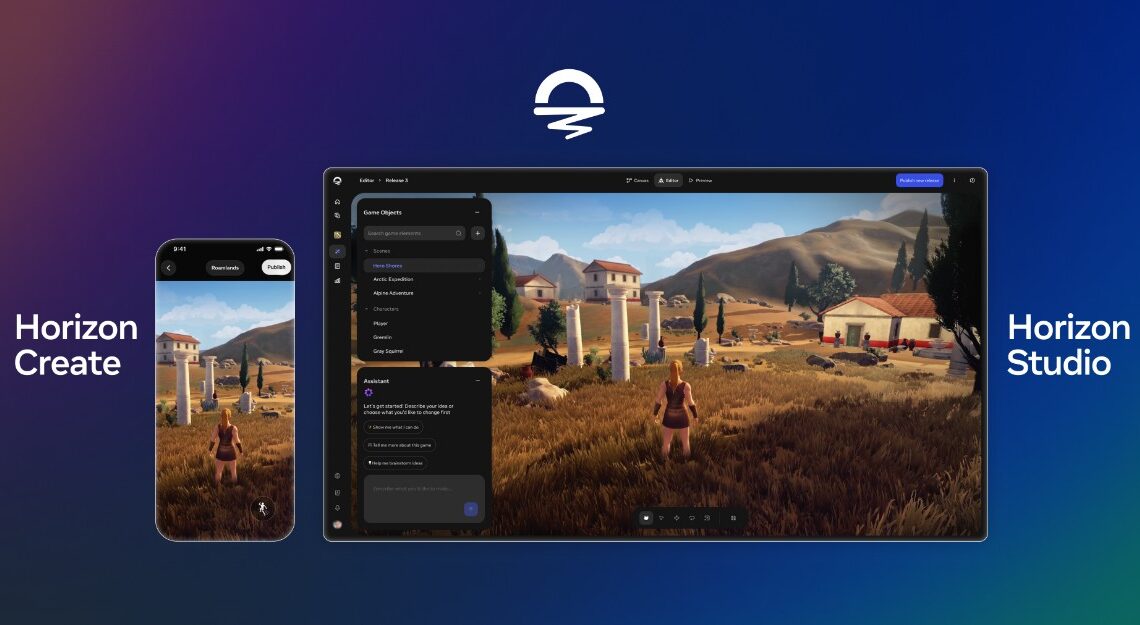
Meta describes Horizon Create as a standalone mobile app that can turn an idea into a 2D or 3D mobile game with prompts. Horizon Studio is the browser-based counterpart, adding more direct controls such as visual editing, asset swapping and script-parameter adjustments.
The intended result is not simply a prototype on a local machine. Meta says games published through the tools become eligible for native distribution across Facebook, Instagram and Horizon. That makes the tools potentially relevant to creators who want to build directly for Meta’s social and Horizon audiences rather than begin with a conventional PC, console or mobile-store publishing workflow.
Eligibility is the important word. Meta says discovery will depend on factors including engagement, stability, cultural relevance and retention. The company has also said that additional monetization details are still to come. Publishing through the tools is therefore not a guarantee of distribution, reach or revenue.
For now, the practical limitation is access. Meta’s public announcement promises gradual early access rather than a firm general-release date. An Android Central hands-on report says Meta expected a wider rollout to start in early 2027, but Meta has not made that timing a public availability commitment in its own announcement.
VR Glasses are a separate route for existing developers
Meta says its VR Glasses hardware will arrive in spring 2027. The company is making v207 SDKs available ahead of that launch for developers using Unity, Unreal, Android or Web workflows, and describes the device as a Quest-compatible platform built around eye-and-hand-first interaction.
For Unity teams, the immediate question is less “can we generate a game with prompts?” and more “what needs adapting before the hardware ships?” Unity says its support is available now through Unity 6.6 or later and Meta XR All-in-One SDK v207. It also says work built for Quest and OpenXR can carry forward.
That does not make support plug-and-play. Unity highlights the device’s eye and hand tracking, while Meta places those controller-free interactions at the center of the platform. Teams should expect to assess interaction design, interface layout, performance and device-specific features rather than assume that a current Quest title is automatically optimized for VR Glasses.
Does Horizon Studio replace Unity?
No, based on what Meta has announced. Horizon Create and Horizon Studio are built around Meta Horizon Engine and publishing to Meta’s services. The VR Glasses developer announcement separately lists Unity, Unreal, Android and Web as supported development paths.
The products can serve adjacent creator audiences, but Meta has not said that Horizon projects export to Unity or that Unity projects can be moved into Horizon Studio. It has also not established public export options for Horizon project assets, game logic or analytics.
Put another way, Horizon Create and Studio appear aimed at people who want a guided path from an idea to a Meta-distributed social or mobile game. Unity support is for developers working in an established engine who want to prepare XR projects for Meta’s next hardware platform.
What creators and developers should do next
- Want to make a game for Meta’s platforms? Join the Horizon Create and Horizon Studio waitlist, but plan around gradual early access rather than a confirmed public-release date.
- Already build in Unity for Quest or OpenXR? Review the VR Glasses requirements, move to the supported Unity and Meta SDK versions when appropriate for your project, and identify where hand and eye interaction could require design changes.
- Need a cross-platform export pipeline? Do not assume Horizon Create or Horizon Studio provides one. Meta has not announced an export route into other engines, platforms or storefronts.
Meta is presenting both announcements as ways to lower barriers to creation, but they lower different barriers. One is a tightly integrated, still-limited creation-and-distribution route into Meta’s services. The other gives established developers a supported path to prepare for hardware planned for spring 2027.