Capcom REX explained: RE Engine plans do not confirm AI-generated assets
October 4, 2026Capcom is evolving RE Engine through REX, but the available evidence points to AI-assisted development and testing rather than AI-generated materials in released games.
Capcom’s REX project does not, on the evidence currently available, mean that its future games will contain AI-generated art, audio or other generative-AI materials.
The more precise reading is narrower: Capcom is evolving its internal RE Engine with technology intended to improve performance, tools, development workflows and quality assurance. Its published policy says materials created by generative AI will not be implemented in game content, while the technology may be used to make the development process more efficient.
That distinction matters because some English coverage has described REX as an “AI-generation game engine.” The underlying reporting supports the idea of an engine being prepared for an AI era, not a confirmed system that will generate complete games or supply AI-generated assets for release.
What Capcom has officially confirmed
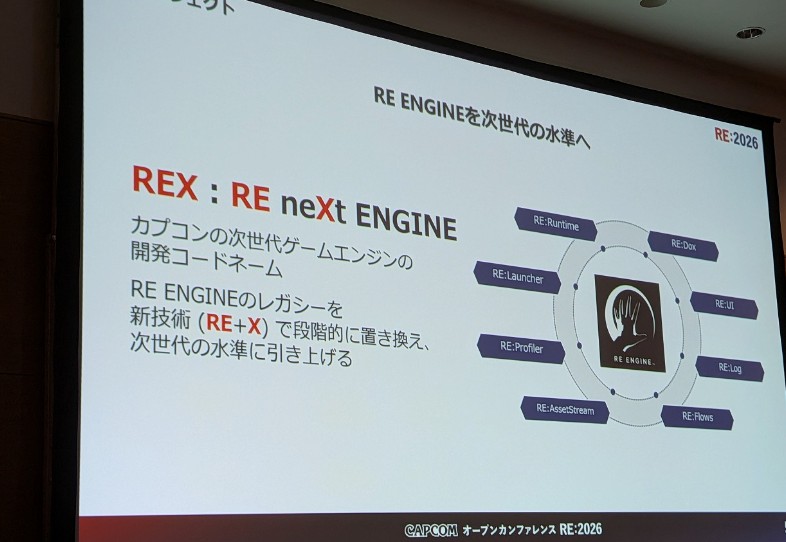
Capcom’s official programme for CAPCOM Open Conference RE:2026 listed an October 2 professional-session presentation in Tokyo about the outlook for REX, a project intended to evolve RE Engine for the next generation. The programme also listed sessions about REAssistAI and autonomous-play AI quality assurance, placing development support and testing within the conference’s wider technical agenda.
Capcom set out a clearer policy boundary in an official investor Q&A published in March 2026. In English translation, the company said: “We will not implement materials created by generative AI in game content.” It immediately added: “On the other hand, we intend to actively use it as technology that contributes to improving efficiency and productivity in the game-development process.”
The same answer says Capcom is evaluating uses across graphics, sound, programming and other disciplines. It does not explain in operational detail how AI-assisted graphics or sound work would be separated from AI-generated material intended for a finished game. Even so, the stated distinction between production assistance and game content is consistent with Capcom’s earlier statement that it would not implement AI-generated materials in game content.
What REX is reported to be
The closest detailed account of the REX presentation is GameBiz’s conference report. Capcom has not provided a full public transcript or slide deck in the material reviewed for this article, so the presentation’s technical details should remain attributed to that report.
According to GameBiz, REX is not a replacement engine being rebuilt from the ground up. It is instead a staged evolution of the existing RE Engine, with additional technologies introduced over time. The report identifies performance, tools, development efficiency and quality assurance as project priorities.
GameBiz also describes possible future capabilities involving AI understanding code, automatically creating programs and conducting test plays to check for bugs. Those are potentially significant development tools, but the report does not provide a deployment date or connect them to a named Capcom game. They should therefore be treated as reported future directions rather than announced product features.
Why “AI-generation game engine” needs context
The ambiguity comes largely from translation. GameBiz uses the Japanese phrase “AI世代,” which can describe an AI era or generation. Rendering it as “AI-generation” in English can make the phrase sound like an announcement of an engine that generates games, even though the reported examples concern programming assistance, workflows and automated testing.
Nothing in the reviewed material confirms that Capcom has announced an engine capable of independently producing complete games. It also does not confirm that REX will introduce generative-AI-created materials into shipped titles. Video Games Chronicle’s English-language coverage similarly frames the reported work around performance, tools, development efficiency and quality assurance while attributing the substantive presentation details to GameBiz.
For players, the practical interpretation is that REX may eventually affect how Capcom’s teams write code, develop systems and test games. That is different from announcing AI-generated visual, audio or narrative assets as part of a finished release.
What Capcom has not announced
The material reviewed for this article contains no public REX release date, title-by-title rollout plan, performance target, consumer-facing feature list or official presentation deck. It also does not establish which proposed technologies are already in production and which remain prototypes or longer-term goals.
It would therefore be premature to connect REX to Resident Evil Requiem, Pragmata or any other individual Capcom release. No named game has been confirmed as a vehicle for the reported AI capabilities.
The strongest conclusion is also the least dramatic one: REX is reported to be a staged modernization of RE Engine with AI-assisted programming and testing among its possible directions. Capcom’s official policy, meanwhile, says it will not implement materials created by generative AI in game content. Further conclusions will require a public presentation, technical documentation or a game-specific announcement from Capcom.