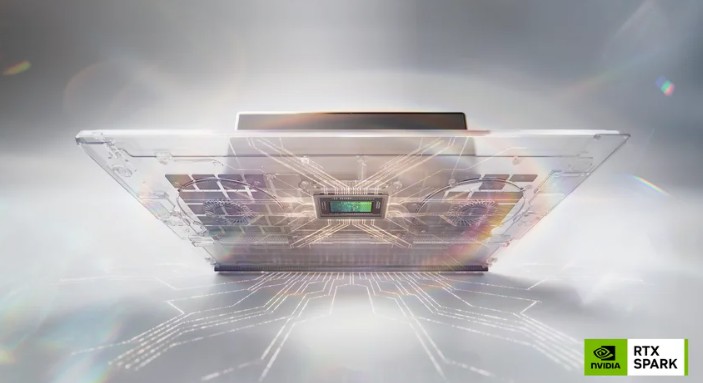
Nvidia unveils RTX Spark: AI superchip set to reshape laptops, claims 1 petaflop of local AI performance
June 2, 2026Nvidia has announced the RTX Spark, a new AI-focused chip designed for laptops and PCs, promising up to 1 petaflop of AI capability, support for up to 128GB unified memory, and integration with leading brands like Dell, Lenovo, Asus, and HP. The RTX Spark will launch in laptops this autumn, representing what Nvidia calls the beginning of the “personal AI computer”.
The RTX Spark chip is Nvidia’s most ambitious push into consumer AI hardware to date. Announced on June 1, 2026, by CEO Jensen Huang through an official company blog post, Nvidia describes the Spark as “purpose built for personal agents”, targeting a new era where generative AI features become standard at the device level. According to Nvidia, “RTX Spark brings everything NVIDIA has built – CUDA, RTX, our AI platform – into a single superchip. Local agents. Frontier models. Creative workflows. RTX games. All on a laptop.”
RTX Spark specs, release window, and features
Key RTX Spark Specifications:
- AI Performance: Up to 1 petaflop
- Unified Memory: Up to 128GB
- Graphics technology: Includes ray tracing, DLSS, and Reflex
- Device Availability: Laptops and PCs from Dell, Lenovo, Asus, and HP
- Release window: Autumn 2026
- Target Use: Local AI agents, creative workflows, gaming, and productivity
Nvidia emphasises that the RTX Spark supports “full-stack” Nvidia AI and graphics, designed to operate seamlessly with Microsoft Windows. The company claims this will deliver unprecedented local processing power for generative AI, eliminating reliance on cloud compute for most tasks. As Huang writes, “For forty years, you launched apps. Click. Type. With RTX Spark and Microsoft Windows, you ask – and the PC does the work.”
Gaming is a clear focus for Nvidia’s new hardware. The RTX Spark chip promises the Nvidia suite of AI and graphics innovations, ray tracing for realistic lighting, DLSS for AI-accelerated upscaling, and Reflex for optimised latency, will now be standard. According to the official announcement, Spark-equipped laptops will run titles at 1440p resolution and over 100 frames per second.
AI hardware demand, industry scepticism, and effects on consumers
The RTX Spark lands amid a period of intense demand for AI-capable hardware, with generative AI reshaping both the PC and gaming markets. Nvidia has become a dominant force in supplying AI chips for data centres, fueling a surge in hardware prices that has reverberated across the personal computer sector. Component price hikes have impacted not only traditional PCs and laptops but also consoles, with both Microsoft and Sony raising prices on the Xbox Series X/S and PlayStation 5. Valve’s Steam Deck has also seen similar cost increases.
Despite industry optimism, scepticism around generative AI in consumer tech is mounting. A 2025 MIT study highlighted potential concerns, reporting that “the tech may be eroding critical thinking skills.” Within the games industry, attitudes are sharply divided: The 2026 State of the Industry Report found “roughly half of professionals thought it was bad for the industry.” Still, Nvidia’s deep integration with AI development has driven continued share price growth, reinforcing its status as a market leader despite ongoing public debate.
Jensen Huang, Nvidia CEO, summed up the moment: “The PC is being reinvented… This is the new PC. The personal AI computer.”
Nvidia’s RTX Spark will begin shipping in laptops and PCs from Dell, Lenovo, Asus, and HP this autumn, with full-stack Nvidia AI and gaming features arriving natively to the desktop for the first time.